How to Choose Crimp Terminal Size by Wire Gauge
Ring, spade, butt splice, and quick-disconnect terminals compared by AWG and mm² — choose the right crimp terminal size for the wire and avoid common mistakes.
Choosing the right crimp terminal starts with the wire. A crimp terminal is the metal connector that joins a wire to a stud, a tab, or another wire, and it only works when the terminal size matches the wire gauge. A terminal that is too large will not grip the wire, and a terminal that is too small will not fit at all. This guide explains the four main crimp terminal types, how to read AWG and mm2 sizes, and the mistakes to avoid.
The Four Main Crimp Terminal Types
Most harness work uses one of four crimp terminal types. Each one suits a different connection:
Ring Terminals
A ring terminal has a closed loop that fits over a stud or screw. It is the most secure choice for connections that must not pull off, such as battery and ground connections. Choose the ring size to match the stud diameter and the wire gauge.
Spade (Fork) Terminals
A spade terminal has an open fork that slides under a screw without removing the screw. It is faster to install and remove than a ring terminal, and it is common on terminal blocks and control panels. Use it where the connection is serviced often.
Butt Splice Connectors
A butt splice joins two wires end to end inside one barrel. It is used to extend a wire or to repair a damaged section. Heat-shrink butt splices add a sealed, waterproof joint for outdoor and engine-bay wiring.
Quick-Disconnect Terminals
Quick-disconnect terminals are flat blade (male) and receptacle (female) pairs that push together and pull apart by hand. They are standard for switches, relays, fans, and appliance connections. Match the blade width, usually 2.8 mm, 4.8 mm, or 6.3 mm, to the mating part.
AWG to mm2 Conversion
Crimp terminals are sized by the wire they accept, listed in AWG or mm2. Use this table to match them:
- 22 AWG = 0.34 mm2
- 20 AWG = 0.52 mm2
- 18 AWG = 0.82 mm2
- 16 AWG = 1.31 mm2
- 14 AWG = 2.08 mm2
- 12 AWG = 3.31 mm2
- 10 AWG = 5.26 mm2
Terminal color codes follow the same sizes: red for 22–18 AWG (0.5–1.5 mm2), blue for 16–14 AWG (1.5–2.5 mm2), and yellow for 12–10 AWG (4–6 mm2). Always check the terminal's printed wire range, not just its color.
Insulated vs Non-Insulated Terminals
Insulated terminals have a vinyl or nylon sleeve over the barrel that protects the crimp and prevents short circuits. They are the right choice for most automotive and appliance wiring. Non-insulated terminals are bare metal: they are smaller, cheaper, and used where space is tight or where a heat-shrink sleeve will be added afterward. For wet or outdoor wiring, choose heat-shrink insulated terminals for a sealed joint.
Plating: Tin, Nickel, and Gold
Terminal plating protects the metal from corrosion and affects the connection. Tin plating is the standard choice for general automotive and appliance wiring: low cost and good corrosion resistance. Nickel plating handles higher temperatures and harsher environments, such as engine bays. Gold plating is used for low-current signal contacts where a stable, low-resistance connection matters most. Match the plating to the environment, not just to the price.
How to Size a Terminal in 4 Steps
- Measure the wire: read the AWG or mm2 printed on the wire insulation.
- Pick the terminal type: ring for studs, spade for terminal blocks, butt splice for wire-to-wire joints, quick-disconnect for blades and tabs.
- Pick the size range: the wire gauge must fall inside the terminal's listed range, for example red 22–18 AWG for a 20 AWG wire.
- Crimp and test: use the crimp tool made for that terminal, then pull-test the joint before the harness is installed.
Common Mistakes to Avoid
- Wrong size: a terminal that is too large for the wire will pull off; a terminal that is too small will cut wire strands.
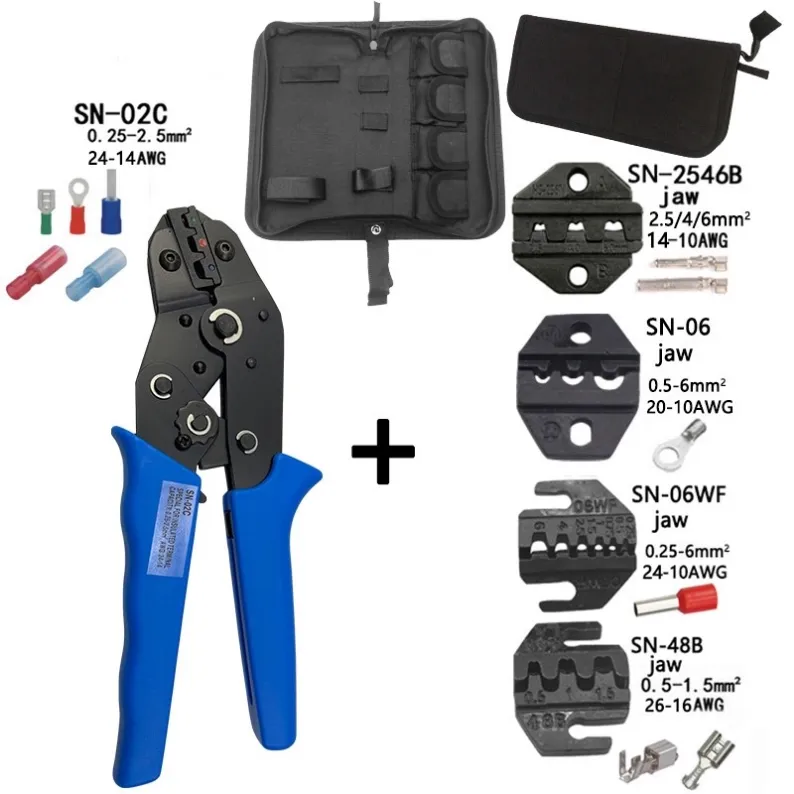
- Wrong crimp die: insulated and non-insulated terminals need different dies — the wrong die crushes the insulation or leaves the barrel loose.
- Over-stripping: bare wire sticking out of the barrel can short to nearby metal; strip only the length the barrel needs.
- Under-stripping: insulation inside the conductor crimp blocks the electrical connection and fails the pull test.
- No pull test: every crimp should be checked with a firm pull before the harness is fitted.
- Reusing a crimped terminal: a terminal that has been crimped once will not crimp properly a second time — always use a new terminal.
When in doubt, size the terminal to the wire first and the connection second. For connector kits, housings, and terminals matched to your harness, see the product catalog or send a message with your wire gauge and application.